How to Paint a Strawberry Plant - A Beginner Friendly Botanical Watercolor Tutorial
My grandfather used to make us strawberry shortcake in the summer. My grandmother had a huge garden and those strawberries came in bright and sweet every year. This week's botanical watercolor tutorial is painted in their honor - and for everyone who ever handed something growing down to the next generation.
How to Paint a Strawberry Plant - A Beginner Friendly Botanical Watercolor Tutorial
Why Paint a Botanical Strawberry Plant?
Your Botanical Watercolor Color Palette
How to Paint the Strawberry Plant - 6 Easy Steps
This Tutorial Is for You - Wherever You Are Today
Fresh From the Garden
There's something about a garden that slows you down.
You can't rush it. You plant something small and you water it and you wait. And then one day - almost without warning - something red and bright and alive is hanging right there where there was nothing before.
My grandmother knew that. She tended her garden quietly, without making a fuss. And my grandfather took what she grew and made something with it. Strawberry shortcake on a summer afternoon. The kind of thing you don't think to write down because you assume it will always just be there.
It isn't always just there.
This summer I'm planting a vegetable garden with my grandchildren. Just seeds and soil and the hope that something will come up. And maybe my grandparents' garden passing quietly into the next generation - through dirt under small fingernails and the thrill of watching something grow.
Why Paint a Botanical Strawberry Plant?
Botanical illustration has a long and beautiful history - artists carefully documenting the natural world one plant at a time. But you don't need to be a botanical artist to paint something that feels alive and real and grounded in the natural world.
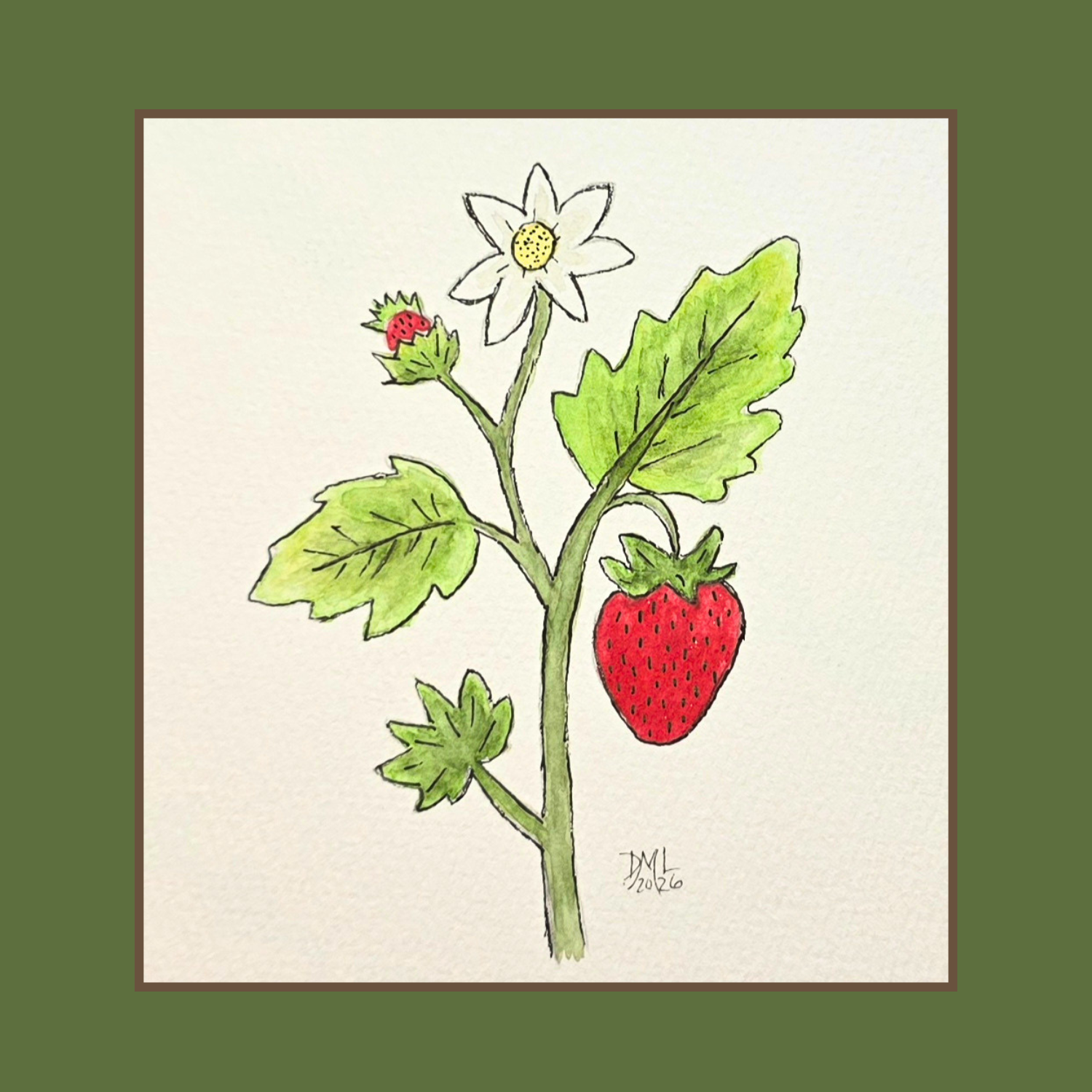
This week's botanical watercolor tutorial is designed for complete beginners. One ripe red berry. One delicate white flower. A handful of richly layered green leaves. Simple enough to trace, satisfying enough to frame.
And the layering technique we use this week - building up color slowly, one wash at a time - is one of the most important watercolor skills you'll ever learn. Once you understand how layers work, everything gets easier.
Your Botanical Watercolor Color Palette
Five colors is all you need for this botanical watercolor tutorial:
Garden Red - a vivid bold red for the ripe strawberry. This is your most powerful color this week - keep it confident and juicy.
Olive Leaf - a deep dark olive green for the larger leaves and main stem. Rich, earthy, and completely botanical feeling.
Sprout Green - a lighter fresher green for the smaller leaves and the calyx around the berry. This is what gives the painting that alive, growing feeling.
Sunshine - a warm golden yellow for the flower center and as a first underlayer wash on the leaves. This is the secret step that makes everything glow.
Petal Gray - a soft cool grey for the shadow on the white flower petals. Remember - wherever you want pure white, just leave the paper bare. The paper does that work for you.
Mixing tip: The secret to these leaves is the layering. Start with a light golden wash of Sunshine first and let it dry completely. Then layer Sprout Green over it, and finally deepen with Olive Leaf in the shadowed areas. Each layer needs to be dry before the next one goes on.
How to Paint the Strawberry Plant - 6 Easy Steps
The full video tutorial is on my video channel at Mind Your Heart Studio (see below). Here's the simple breakdown:
Step 1: Lightly sketch or trace the outline of the plant and berries. Tracing is completely fine - it removes drawing anxiety and gets you straight to the painting.
Step 2: Paint the flower petals light gray and add a golden wash of Sunshine to the leaves. This warm underlayer is what gives the leaves their natural depth.
Step 3: Paint a layer of light Sprout Green over the leaves. Let it dry completely before moving on.
Step 4: Paint the leaves and stems with a layer of Olive Leaf, deepening the shadows and adding richness.
Step 5: Paint the berries vivid red with Garden Red. This is the most satisfying step - watch the whole painting come alive.
Step 6: Outline and add details with a permanent black fine tip pen. This is the step that makes everything look intentional, finished, and beautifully botanical.
What Gardens Teach Us
Gardens teach you something if you let them.
They teach you that good things take time. That you can't force a strawberry to ripen any faster than it's ready. That some of the most beautiful things in life start as something so small you can barely see it - and then one day there it is, vivid and real and completely worth the wait.
I think creativity works the same way. You pick up a brush and you're not sure what you're doing. You make something small and imperfect and you set it aside. And then slowly - layer by layer, week by week - something grows. A habit. A confidence. A quiet pride in what your own hands can make.
That's what you're building here. Not just paintings - but something that grows.
This Tutorial Is for You - Wherever You Are Today
Whether you're an experienced painter or picking up a brush for the very first time, this botanical watercolor tutorial is designed to meet you exactly where you are. No pressure. No comparison. Just a beautiful little plant, a warm summer palette, and a quiet hour that belongs entirely to you.
If this little strawberry plant brought back a garden memory - a grandmother's yard, a summer afternoon, something fresh and homegrown - I'd love to hear about it - and if you painted it, I'd love to see! I have a private Facebook group you can join and post and share your work (there's a link at the end of this blog post to join). 🍓
FAQs About This Botanical Watercolor Tutorial
Do I need any art experience for this botanical watercolor tutorial? Not at all. This tutorial is designed for complete beginners. A tracing guide is available in the description of my tutorial on YouTube, so you never have to worry about drawing the plant from scratch.
What supplies do I need? A basic watercolor set, one or two brushes in different sizes, watercolor paper, a jar of water, and a black fine tip pen for the finishing details. You don't need expensive supplies to create something beautiful.
How long will it take? Most beginners complete this painting in thirty to forty-five minutes. The layering technique requires a little drying time between steps - perfect for a slow quiet morning with a cup of tea.
What is the layering technique and why does it matter? Layering means building up color in thin transparent washes rather than applying one heavy coat. It gives watercolor paintings depth, dimension, and that luminous quality that makes them look alive. This tutorial is a perfect introduction to the technique.
Where can I find the full video tutorial? The full step by step video is on my video channel at Mind Your Heart Studio. You can also get the complete Creative Heart Journal - including the color palette, tutorial steps, and Heart Practice of the Week - delivered free to your inbox every Friday.
A Small Invitation
If you've been quietly curious about watercolor and just needed a reason to begin - this might be it. The Creative Heart Journal is free and arrives in your inbox every Friday. When you sign up you'll also receive my Whimsical Bird Trio Starter Pack as a welcome gift - everything you need to paint your very first watercolor card in about thirty minutes.
👉 Sign up here: creativewannabes.com/sign-up
And if you'd like to join a warm welcoming group of women - no judgment, no comparison, just color and kindness - come join us at our free Facebook Group:
👉https://www.facebook.com/groups/createwithmissusmidlife
Lastly, if you'd like to attend a free beginner watercolor paint-along workshop, you can sign up for the next live (online on Zoom) event here:
👉 https://kitchentablecreativity.com/free-workshop
With heart and color, 💛 Donna

